

There is a moment described early in this chapter that I have not been able to shake since I first read it.
The author does not frame it as a crisis. He does not announce it with urgency. He simply names it — quietly, almost clinically — and that quietness is what makes it so unsettling:
"We stand at a time when the marketplace has invaded the holy place, when worship is shaped more by algorithms than by altars, when ministers are tempted to draw from the pot before the sacrifice is complete."
— Fleshhook, pg. 9
Read that again.
Not because it is difficult to understand. But because it is difficult to sit with.
Because if we are being honest — and this book club is a space for honesty — most of us have participated in exactly what he is describing. Not out of malice. Often out of habit. Out of the slow drift that happens when no one is tending the fire closely enough to notice when strange fire has replaced it.
The Altar Was Never Meant to Serve Us
Chapter 1 opens a diagnosis. Not a condemnation — a diagnosis. And there is a difference. Condemnation assigns blame and walks away. Diagnosis names the condition so that healing can begin.
The author's diagnosis is precise: we have inverted the altar. What was designed to be the place where we bring an offering to God has gradually become the place where we come to receive an experience from God. And the distinction matters more than most of us have been taught to believe.
Worship is not what God gives us to feel. It is what we give God because of who He is.
The priest's assignment in the Old Testament was not to curate an atmosphere. It was not to manage crowd sentiment or calibrate the temperature of the room. The priest was assigned to tend the fire. To ensure the offering reached God completely, according to the pattern He prescribed. Nothing added. Nothing withheld. Nothing intercepted on the way to the altar.
That is still the assignment.
And the question this chapter places before every reader — whether you are a worship leader, a pastor, an intercessor, or someone who simply shows up on Sunday — is this: are you tending the fire, or are you managing the experience?
The Fleshhook in Modern Clothing
The sons of Eli did not abolish the altar. They simply repositioned themselves in relation to it. They did not stop the offerings from coming — they intercepted them. They thrust the fleshhook into the pot before the fat had been given to God. They helped themselves before the sacrifice was complete.
And the author makes clear that this is not an ancient problem confined to a corrupt priestly family in 1 Samuel. It is alive. It is current. It wears contemporary clothing.
"The same inversion thrives in our age — not in the form of a three-pronged fleshhook plunged into a boiling pot, but in setlists built for applause rather than adoration, in sermons adjusted for palatability rather than purity, and in congregations trained to measure 'good worship' by how it made them feel rather than by whether God was pleased."
— Fleshhook, pg. 10
This is the confrontation of Chapter 1. Not at the institution. Not at other churches or other ministers. At us. At the posture we have each individually settled into — perhaps without realizing when the shift happened.
The author introduces two roles that are both our responsibility: the priest and the prophetic watchman. The priest tends the altar — keeps the fire burning according to divine prescription, not human preference. The watchman guards the gate — not only watching for the enemy but guarding against the internal drift from sacred fire to strange fire.
We are called to be both. And most of us have been neither.
Recognizing the Inversion
One of the most helpful frameworks in this chapter is what the author calls the Cycles of Loss and Renewal: visitation, institutionalization, exploitation, prophetic intervention. This is the pattern through which genuine moves of God tend to erode — not through sudden attack, but through gradual accommodation.
The visitation becomes a program. The program becomes a brand. The brand becomes something to protect. And somewhere in the protection of the thing, the glory quietly departs — while the machinery continues running at full capacity.
The program can keep running. The building can stay full. The calendar can remain packed. And heaven can have already moved on.
The prophetic watchman is the one who notices. Not because they are looking for problems, but because they are close enough to the fire to feel when it has changed. When the heat is no longer holy. When what is burning is no longer what God prescribed.
Chapter 1 is an invitation to become that watchman — in your own worship, in your own ministry, in your own house. Not to police others. To examine yourself.
✦ Reflective Questions
These are for your journal. Take your time. The goal is not a quick answer — it is an honest one.
📖 FOR YOUR JOURNAL — Reflect Privately
1. When did worship shift for you — from something you brought to God, to something you came to receive from Him? Can you identify the moment, the season, or the pattern that produced that shift?
2. The author describes two roles: the priest who tends the fire and the watchman who guards the gate. Which role do you most naturally occupy in your spiritual life right now? Which do you avoid — and what does your avoidance reveal?
3. He warns that 'the program can keep running, yet the glory has departed.' Be honest with yourself: is there an area of your worship life — personal or corporate — where the form remains but the fire has quietly gone out?
4. Strange fire is defined as worship that looks correct from the outside but is not what God prescribed. Name one thing in your current worship practice that may have drifted from sacred fire into strange fire. What would it take to correct it?
✦ Join the Conversation
These questions are for the comment section. You do not need a polished answer. You need an honest one. Respond to whichever one resonates — and read what others share. We are forming community around the same recognition.
💬 LEAVE A COMMENT — Engage the Community
1. The author says congregations have been 'trained to measure good worship by how it made them feel rather than by whether God was pleased.' Finish this sentence in the comments: 'I know I've been measuring worship by how it made me feel when ___.'
2. The fleshhook represents taking before the offering is complete. Without naming names or institutions — what does a modern fleshhook look like in the spaces you have inhabited? What does it sound like? What does it justify itself as?
BEFORE YOU LEAVE THIS PAGE
① PARTICIPANTS: Your first journal assignment is waiting. Before the next session, complete the N.A.M.E.S. method for Chapter 1 — number the paragraphs, arrange in chunks, mark your text with your four colors, expound in your journal, and write your personal summary. Bring it. We will need it.
② PARTICIPANTS: Post your response to at least one of the engagement questions in the comments before our next session. Your reflection matters to this community — and Dyrell is reading every one.
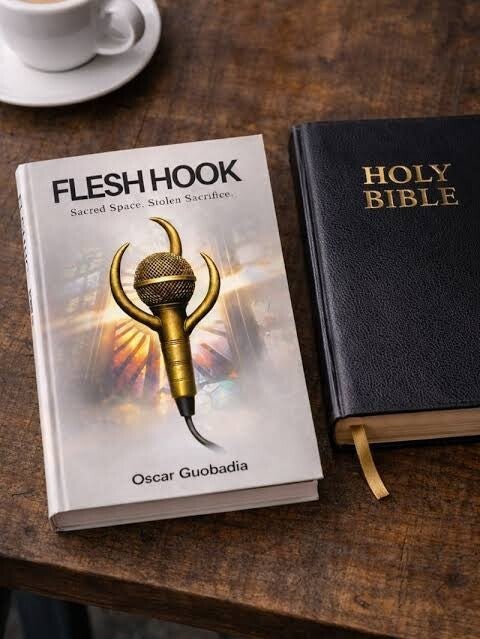
③ NEW HERE? If you found this post and do not yet have the book — this is your sign. Fleshhook by Dr. Oscar Guobadia is available on Amazon. And the next cohort of this book club is forming. Visit jamiciapinkfisher.com to learn more and join us.
FROM INFORMATION TO TRANSFORMATION
This week — before any worship activity, whether personal devotion or a corporate gathering — pause at the threshold and ask yourself one question: 'Am I coming to this as a priest bringing an offering, or as a consumer expecting an experience?' You do not have to fix it in a day. But you have to be willing to name it. That naming is where transformation begins.
"Either we reclaim the altar and restore the offering to its rightful order — or we will find ourselves presiding over a beautiful service that heaven ignores."
— Fleshhook, pg. 13
Post 1 of 2 | Fleshhook Book Club | jamiciapinkfisher.com
Add comment
Comments